
Does the Tariff Refund Process Apply to My Business?
Key Takeaways
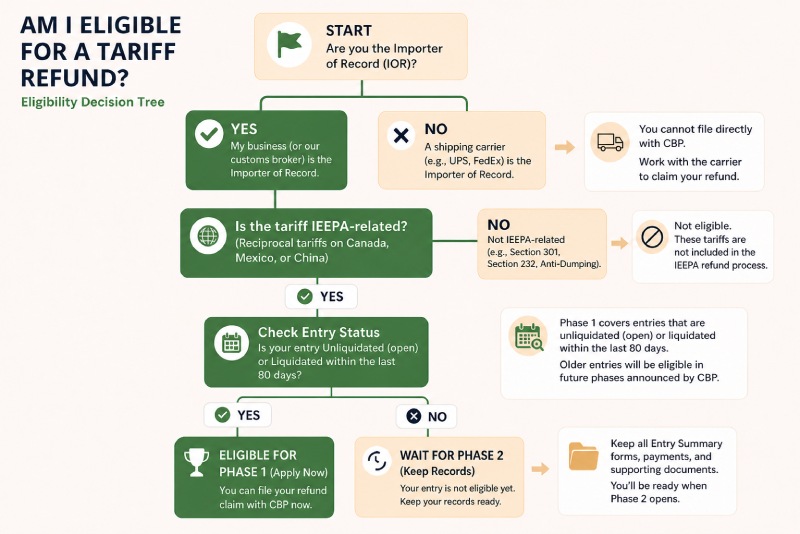
- Only the Importer of Record (IOR) or an authorized customs broker can claim a refund. If a carrier like UPS or FedEx is the IOR, you must coordinate with them rather than filing directly with the CBP.
- Refunds are exclusively for IEEPA-related tariffs (reciprocal duties on Canada, Mexico, and China). Note that Section 301, Section 232, and Anti-Dumping duties are currently not eligible.
- To file immediately, your entries must be unliquidated (open) or liquidated within the last 80 days. Older shipments are expected to become eligible in future phases announced by the CBP.
The federal government is currently holding upwards of $166 billion in tariff overpayments. As of April 20, 2026, the door to reclaim your share is officially open.
But these aren’t automatic stimulus checks. Your path to a refund depends entirely on your status as the Importer of Record and the specific nature of your customs paperwork.
Let’s walk through whether or not you qualify and which specific tariff codes are now eligible for an immediate refund.
Who qualifies for a tariff refund?
To qualify for an IEEPA tariff refund, you must be the Importer of Record (IOR) or an authorized customs broker who paid the tariffs directly.
The Importer of Record (IOR) is the individual or entity legally responsible for ensuring imported goods comply with all laws and for paying all duties and tariffs.
Most small businesses act as their own IOR unless they use a third-party shipping service (like FedEx or UPS) to handle the entire import process.
So, how do you determine if you are the IOR?
The easiest way to do this is by reviewing your paperwork:
- Look at your Entry Summary form (CBP 7501).
- If your business name and tax ID are listed as the Importer of Record, you are entitled to claim the refund directly.
- If a customs broker is listed, they can often apply for the refund on your behalf.
If you used a major shipping carrier like UPS or FedEx, they might be the IOR. In this case, you cannot apply directly to U.S. Customs and Border Protection (CBP).
You must work with the carrier in the tariff refund process. For example, UPS has stated they will apply for refunds for eligible customers and pass the funds through once received.
Which tariffs are eligible for refund?
The tariff refund process specifically applies to IEEPA tariffs. These include the “reciprocal tariffs” and those placed on imports from Canada, China, and Mexico. Not Section 301 (China), Section 232 (Steel/Aluminum), or Anti-Dumping duties.
To see if your shipment qualifies, look at your customs paperwork for a Harmonized Tariff Schedule (HTS) Chapter 99 code. Think of this code as a red flag that indicates an extra emergency duty was tacked onto your standard costs.
Also, refunds are currently being issued in stages. During Phase 1, refunds are strictly limited to two specific categories:
1. Unliquidated entries. These are open shipments where you’ve paid an estimated tariff, but the CBP has not yet finalized the total fees.
This would include a local boutique owner who just imported a crate of hand-painted ceramics from Mexico last week, for example.
The shipment has arrived, and the estimated tariff was paid, but U.S. Customs hasn’t closed the book on it yet, making this an unliquidated entry. In a situation like this, you can apply for a refund immediately.
2. Recently liquidated entries. These are shipments finalized (closed) within the last 80 days.
This would apply to a new tech startup that brought in a bulk order of specialized sensors from China three months ago, as another example. They received a final notice from Customs 45 days ago stating the fees were finalized.
The entry is “liquidated,” but it happened within the last 80 days, putting it within the Phase 1 window.
If your entry was liquidated more than 80 days ago, it is currently ineligible. But the CBP has stated they plan to open refunds for these older shipments soon. Keep your records organized so you’re ready to file the moment the timeline is announced.
Final thoughts
Let’s take the first step toward getting your money back where it belongs by verifying your refund eligibility.
Book a call, and we’ll look directly at your Entry Summary forms and HTS codes to confirm whether you’re in the window for an immediate Phase 1 payout.
calendly.com/eco-tax-free-consultation/meeting
FAQs
“How much are the tariff refunds?”
Following a landmark Supreme Court decision this past February, the government has opened the door for businesses to reclaim upwards of $166 billion in previously paid tariffs. By early April, over 56,000 importers had already secured their spot for electronic refunds, totaling roughly $127 billion.
“Am I entitled to interest on my tariff refund?”
Yes. Under federal law, the CBP is required to pay interest on any overpayments, including these IEEPA duties. Interest begins accruing the moment you deposit your estimated duties and continues until the government officially processes your refund. Currently, the interest rate sits at 6%. With the Court of International Trade (CIT) noting that interest is piling up at a rate of roughly $650 million every month, there is a significant financial incentive for you to get your claim filed as soon as possible.
“What if a shipping carrier like UPS or FedEx handled my imports?”
If you imported goods through a carrier that acted as the Importer of Record (IOR), you cannot file a claim directly with the CBP. Instead, you must coordinate with that carrier. Most major shipping companies have already established internal processes to apply for these refunds on behalf of their clients and pass the payments through once the government releases the funds.
“Is there a deadline for filing a tariff refund claim?”
For Phase 1, the window is quite tight. Currently, you can only file for shipments that are either still open (unliquidated) or were finalized (liquidated) within the last 80 days. If your shipments are older than that, they are not eligible today, but you should keep your records organized. The CBP plans to open future phases to address the millions of shipments that fall outside this initial window.