
What’s The Last Date For Employers To Send Out W-2 Forms to Employees?
Key Takeaways
- W-2s and 1099-NECs must be sent to workers by February 2, 2026 (for the 2025 tax year).
- Those same forms must also be filed with the government by February 2, 2026, whether you file electronically or on paper.
- If you file 10 or more total information returns, electronic filing is required.
- Penalties for not sending/filing by the deadline range from $60 to $680 per form, depending on how late or inaccurate the filing is.
If you’ve owned your business for long, you’re familiar with the rhythm: A new year begins. 1099s and W-2s have to be reported and sent out.
But we’ve gone all the way around the sun since you last completed this task. So, I wanted to give you a refresher on best practices for knocking it out before the deadline. And, update you on the last date for employers to send out W-2 and 1099 forms for 2026.
What’s the last date for employers to send out W-2 and 1099 forms?
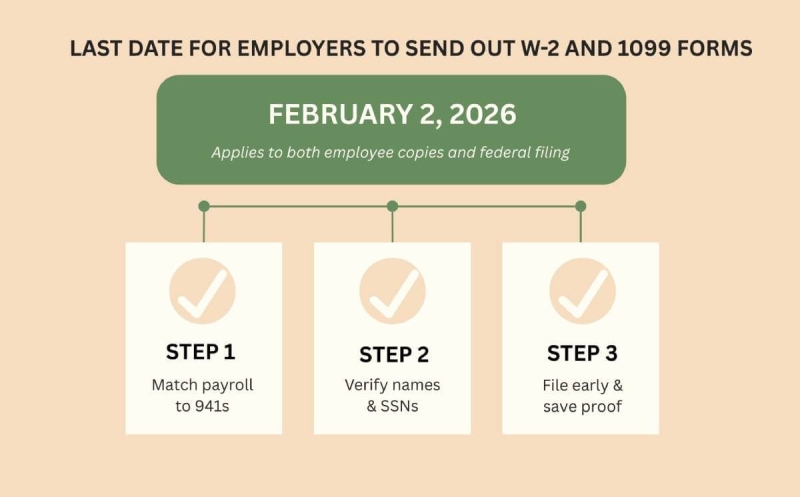
For the 2025 tax year, the key date to know is February 2, 2026. By that date, as an employer, you must do two things at the same time:
- Provide Form W-2 to each employee
- Provide Form 1099-NEC to each qualifying independent contractor
That same February 2 deadline also applies to filing those forms with the government. W-2s are filed with the Social Security Administration, and 1099-NECs are filed with the IRS. (And unfortunately, penalties apply even if employees received their copies on time.)
But although February 2 is legally the last date for you to send out W-2 and 1099 forms, it’s actually not the date I recommend you aim for.
A much safer target filing date that I’m recommending to my clients is January 25. If you find an error after you file but before the February 2 deadline, you can often “delete” or “replace” the submission in some software systems without it ever being considered a formal error. Once February 2 passes, you are forced to file a formal W-2c to make corrections (which is much more tedious).
And yes, even if your payroll service prepares and files the forms, you are still responsible for ensuring W-2s and 1099s go out by February 2, and you receive and retain proof of submission.
Do I have to file 1099s and W-2s electronically?
The IRS requires electronic filing if you submit 10 or more total information returns. The IRS adds everything together: W-2s, 1099-NECs, 1099-MISCs, 1095s, and other information returns.
Let’s say you have 6 employees and 5 contractors. You might think, “I’m under 10 for each type of form, so paper filing is fine.”
But the IRS counts the total forms (11, in this case), so then you’d be required to e-file.
Even if you’re below the 10-form threshold, e-filing is still the cleaner option. It provides instant confirmation from the SSA or IRS and creates a clear audit trail showing when and how your forms were submitted.
Can state deadlines impact 1099 and W-2 filing?
Federal deadlines are only part of the picture. Some states extend their deadlines beyond February 2, 2026, and have different rules regarding electronic filing and other caveats. So, the safest approach is always to get this done plenty early (another reason to aim for January 25th as your deadline) and double-check your state’s guidance each year.
And regardless of your state, your federal filing of W-2s and 1099s to the Social Security Administration (SSA) must be completed by February 2, 2026.
Since not all of our clients’ businesses are registered locally, here’s a table for you to quickly reference your state’s W-2 deadline:
| W-2 Deadline | States |
| February 2, 2026 | Alabama, Arizona, Arkansas, Colorado, Connecticut, Delaware, District of Columbia, Georgia, Hawaii, Idaho, Illinois, Indiana, Kentucky, Louisiana, Maine, Maryland, Massachusetts, Michigan, Mississippi, Missouri, Montana, Nebraska, New Jersey, New Mexico, North Carolina, North Dakota, Ohio, Oklahoma, Oregon, Pennsylvania, Rhode Island, South Carolina, Utah, Vermont, Virginia, West Virginia, Wisconsin |
| February 17, 2026 | Iowa |
| March 2, 2026 | Alaska, California, Florida, New Hampshire, New York, Nevada, South Dakota, Tennessee, Texas, Washington, Wyoming |
(State 1099 details get a bit trickier, so here’s a helpful list where you can find your state’s requirements.)
How do I get W-2s and 1099s filed accurately and on time?
Step 1: Match payroll totals to your 941s.
Before you file anything, start by comparing your payroll totals to what you reported on your quarterly Form 941 filings (specifically the wage and tax lines). If something doesn’t line up, it’s usually a missed overtime entry, a bonus that posted late, or a year-end adjustment that never made it into payroll.
Fix the issue in your payroll system first. Don’t change W-2 totals just to make them match an error upstream.
Step 2: Review employee names and Social Security Numbers carefully.
The SSA’s SSN Verification Service allows you to verify multiple employees at once, and usually only takes a few minutes. It also helps to ask employees to review their final 2025 pay stub. That’s often when spelling issues or outdated information come to light, before forms are filed and penalties come into play.
Step 3: Submit early and save proof.
If possible (and as previously mentioned), file by January 25 rather than waiting until the February 2 deadline. This will give you time to make corrections if you need to. Once your submission is accepted, download and save your SSA confirmation receipt and keep it for at least four years.
Another date I recommend you set a reminder for is March 4, 2026. That’s the last day to file a corrected W-2 (Form W-2C) and still remain in the lowest penalty bracket.
What are the penalties if I miss the deadline for 1099s and W-2s?
The IRS takes these deadlines seriously because they affect the ability of your workers to file their own tax returns on time.
However, the IRS does provide annual maximum penalty caps for small businesses – pay attention if you averaged annual gross receipts of $5 million or less over the last three years.
For the 2025 tax year (filed in 2026), the per-form penalties and small business maximum caps are:
- Up to 30 days late: $60, with a max cap of $239,000.
- 31 days late through August 1: $130, with a max cap of $683,000.
- After August 1 (or not at all): $340, with a max cap of $1,366,000.
- Due to intentional disregard: $680, or 10% of the aggregate amount required to be reported (whichever is greater). No cap.
These penalties apply separately for failing to file with the government and failing to provide a copy to the worker. Which means a single missing W-2 could technically result in a double penalty.
If you do miss the deadline, your first move should be to file ASAP. Because penalties are tiered. So the sooner you correct the error, the lower the fine.
You may also be able to request a penalty waiver if you can show reasonable cause, such as a federally declared disaster or an unavoidable absence, and that you acted responsibly both before and after the failure occurred.
Final thoughts
If getting your 1099s and W-2s squared away by January 25 sounds like a heavy load, let’s talk. Because while it might mean a little extra sweat early in the month, having that buffer week to catch mistakes could save you a lot of stress later.
So, let’s tackle this together:
calendly.com/eco-tax-free-consultation/meeting
FAQs
“What is the official 2026 deadline for W-2 and 1099-NEC forms?”
For the 2025 tax year, the deadline is February 2, 2026. While the date is normally January 31, it moves to the next business day in 2026 because the 31st falls on a Saturday. This deadline applies to both providing the forms to your workers and filing them with the government.
However, a much safer deadline to aim for is January 25. Filing by this date gives you time to correct any mistakes that might’ve slipped through, so you can avoid penalties.
“Can I get an extension for filing W-2s or 1099-NECs?”
Extension requests for these forms are not automatic and are rarely granted. You must file Form 8809 by February 2 and provide a detailed explanation of the “special circumstances” or hardships that prevent on-time filing. Even if granted, an extension usually only provides an extra 30 days.
“Am I required to file my W-2s and 1099s electronically this year?”
The IRS now requires electronic filing if you are submitting 10 or more total information returns. To reach this number, the IRS adds together almost all forms you file, including W-2s, 1099-NECs, 1099-MISCs, and 1095s. If your total count is 10 or more, paper filing is no longer an option.
“What happens if I miss the February 2 filing deadline?”
The IRS is strict with payroll-related deadlines. Penalties for the 2025 tax year start at $60 per form if you file within 30 days of the deadline. If you wait until after August 1, that penalty can jump to $340 per form, and “intentional disregard” can cost you $680 per form with no maximum limit.
“How do I file W-2s and 1099s if I missed the deadline?”
You should still file as soon as possible to stop the penalty clock from ticking. W-2s are filed with the Social Security Administration (SSA) via their Business Services Online (BSO) portal. For 1099-NECs, you can use the IRS Information Returns Intake System (IRIS), which is a free portal for small businesses.
“Do I need to file a 1099-NEC for every contractor I paid?”
You only need to file Form 1099-NEC if you paid an independent contractor $600 or more during the 2025 tax year. Note that this threshold is scheduled to increase to $2,000 starting in the 2026 tax year (for forms filed in 2027).
“My payroll service handles my W-2s; am I still liable for errors?”
Yes. Even if you use a third-party payroll provider, the IRS holds the business owner ultimately responsible for the accuracy and timely submission of these forms. Always request a confirmation receipt from your provider to keep for your records.